Document generation for P&C and surety carriers

Fill the PDF forms you already have, or design new documents from your data. necodoc runs in your own cloud.

  • Docker Compose or Helm
  • Postgres
  • Entra ID · Auth0 · SiteMinder
  • EN and fr-CA from one template
  • MIT licence
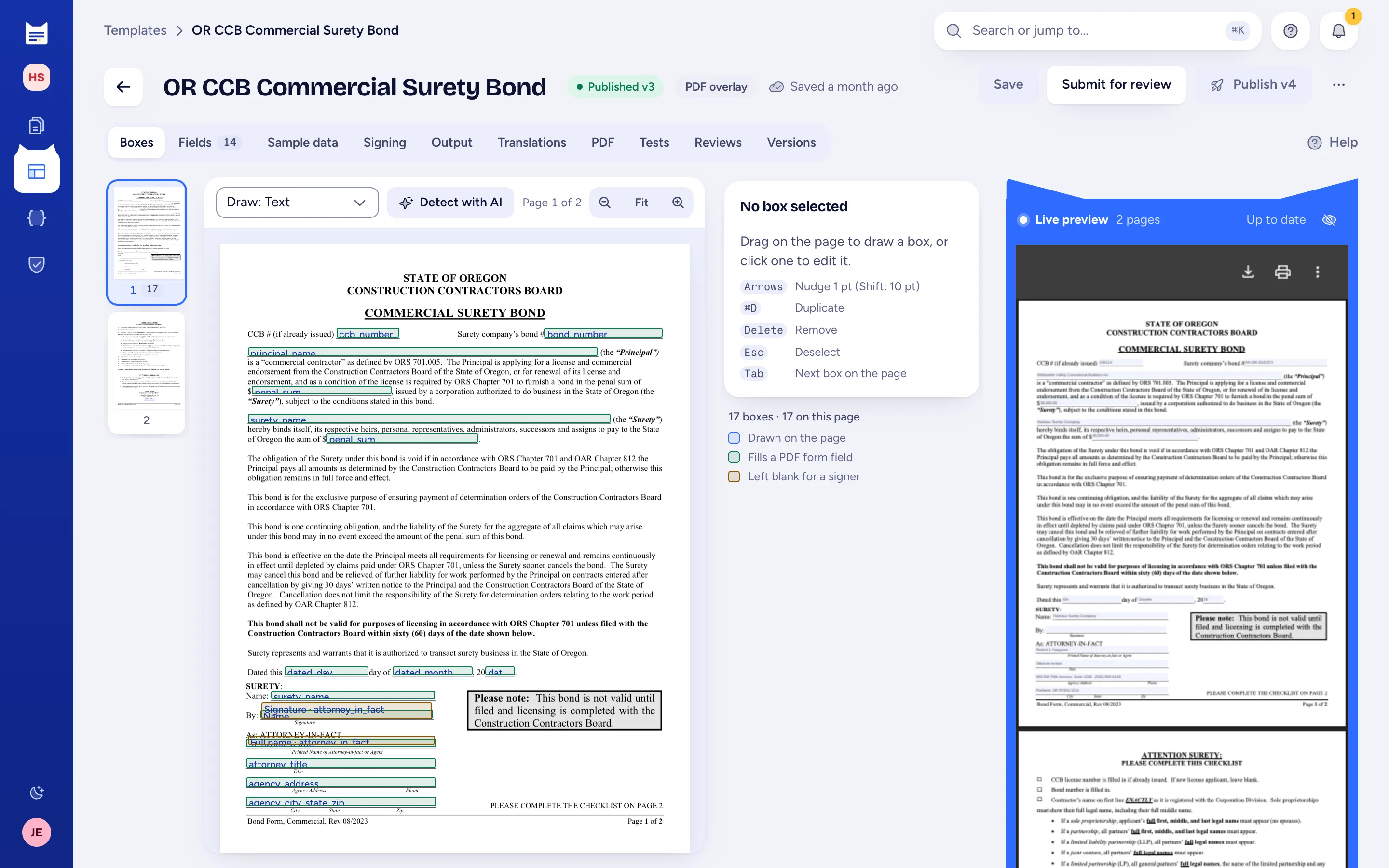
Overlay editorOregon CCB commercial surety bond
The overlay editor: the Oregon Construction Contractors Board commercial surety bond with fields drawn on the page and a live preview of the filled PDF.

Product tour

From the obligee's PDF to a renewal run.
  1. Upload the bond form; AI proposes boxes, you confirm
  2. Designed templates with conditional sections
  3. Guided form to finished PDF
  4. HTML to PDF from your policy system
  5. Batches that scale out with workers
  6. E-signature ready signing packages
  7. Audit log, generation log, your cloud
28 ms
Overlay render, p50
Flat surety bond form, fields stamped. p95 30 ms
30 ms
HTML to PDF, p50
Three-page invoice with header and footer bands, over /api/v1/render
43,430
Documents per minute
JSON batch on 8 workers, one per server; 5,950 on one
$0
Licence fee per worker
You pay for the machines. Nothing else.
Apple M5, 10 cores, 32 GBmeasured 2026-10-12 · commit b359f12local stack, sequential latency, 100 samplesMethod, caveats and how to rerun it →

What it does

Built for the documents a carrier already issues.

01Overlay

Fill the forms you already have.

Place fields on the obligee's bond form or the regulator's PDF. The output is their page, with your data on it.

  • Flat PDFs with no fields, or import the AcroForm fields that are there
  • AI proposes the boxes, and a person accepts each one. AI is off until you set ANTHROPIC_KEY
  • Government PDFs with an empty password and hybrid XFA forms open as-is
Limit: Pure XFA forms and PDFs that need a password to open aren't supported.
Overlay editor: fields drawn on the board's PDF

02Speed and scale-out

Add workers for month-end. Remove them after.

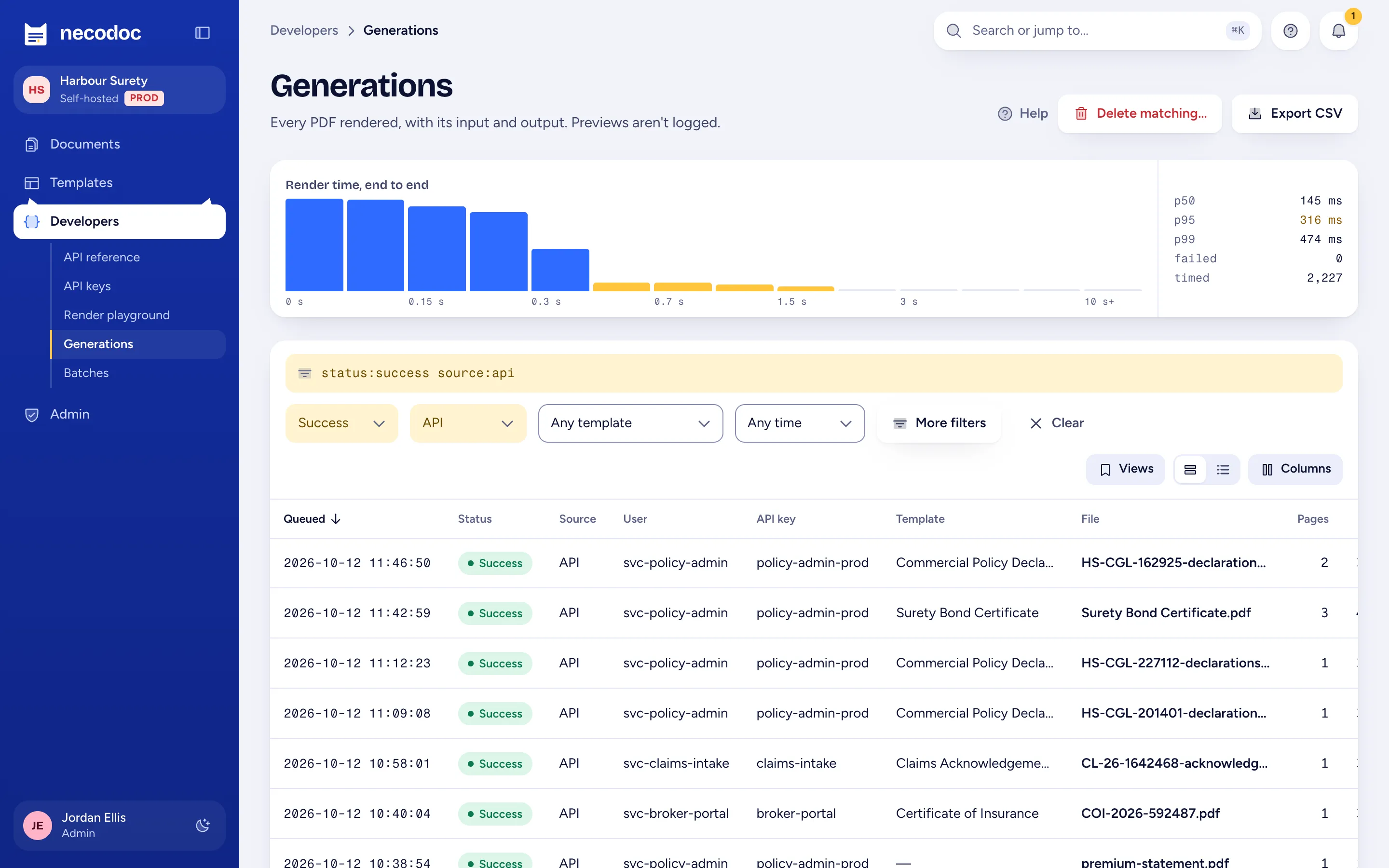
Scale render workers up for month-end and back down after, with no licence per worker. Every render records its step timings.

  • Interactive renders jump ahead of batch rows
  • Batches of up to 10,000 rows from JSON or CSV, with progress, cancel, a ZIP or one packet
  • Every PDF logged with input, version and a timing breakdown, and re-runnable
Limit: Postgres holds the queue, so it sets the throughput ceiling.
Generation log with a render-time histogram and p50, p95 and p99

03Insurance fit

Built around bonds, certificates and policy packets.

necodoc speaks the language on your forms: principal, surety, obligee, attorney-in-fact, declarations page, renewal run.

  • Signing packages with principal, surety and attorney-in-fact signers
  • Certificates and policy documents combined into one packet
  • English and fr-CA from one template, with one set of fields and one layout
  • PDF/A-2 for archives, PDF/UA-1 for accessible formats, PAdES certification
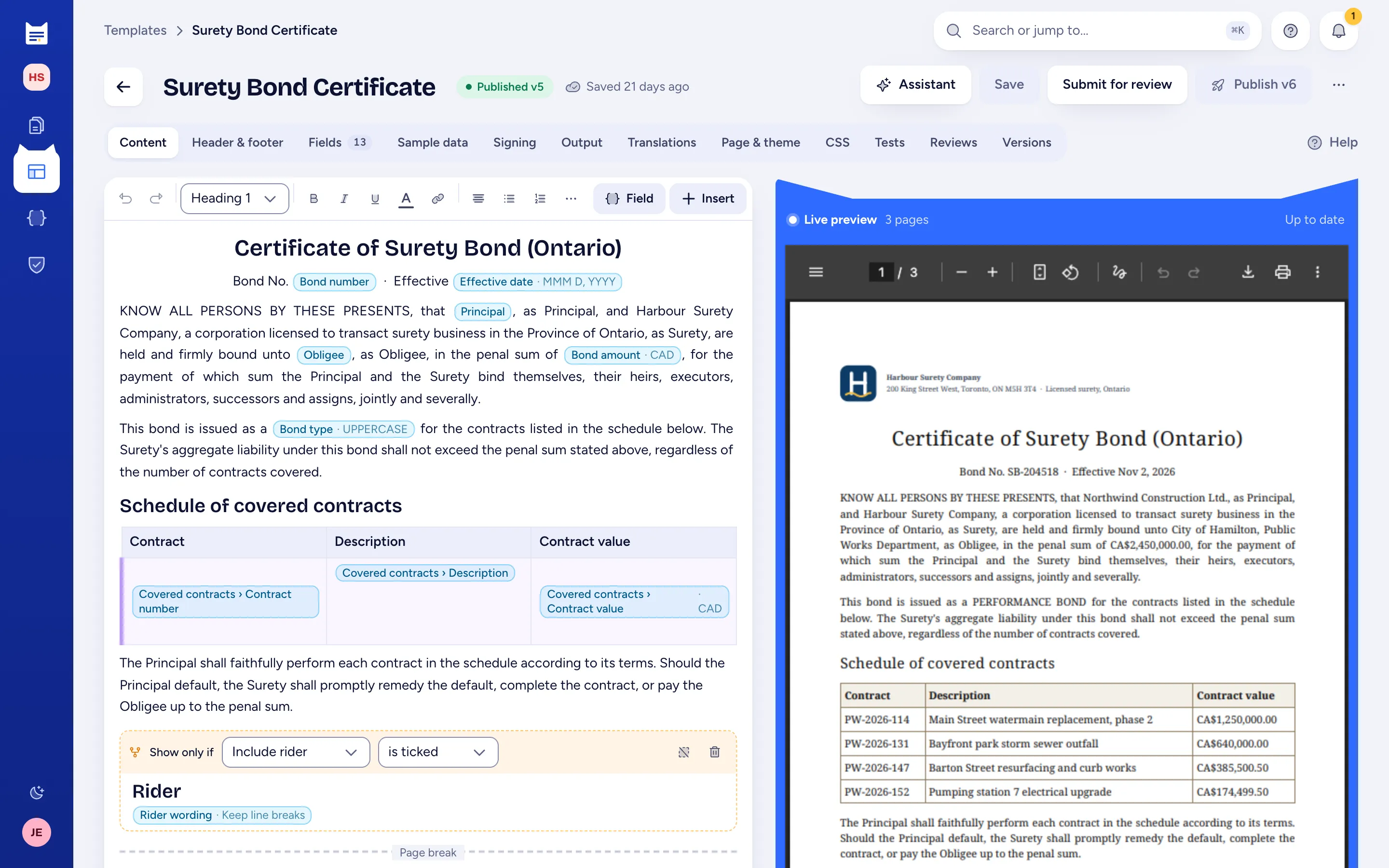
E-signature ready: necodoc prepares the signing package. Your DocuSign, Dropbox Sign or Acrobat Sign account runs the legally binding signature.
Designed template editor: a certificate of surety bond for Ontario with typed fields and a live preview in CAD

Reference architecture

It all runs inside your boundary.

One image runs as the API or a render worker. State lives in your Postgres and bucket. Dashed arrows are optional outbound calls, off until you configure them.
necodoc reference architecture Core systems, staff and share-link users reach a stateless necodoc API through your load balancer. The API stores templates, logs, the audit log and the job queue in your Postgres, and issues signed links to PDFs in your object storage. Render workers claim jobs from Postgres, render with headless Chromium and write PDFs to storage. Sign-in goes through your identity provider; metrics, traces and logs go to your observability stack. Outside the trust boundary, and optional: webhooks to your endpoints, your e-sign provider integration, and the Anthropic API only when AI is enabled. YOUR CLOUD ACCOUNT OR DATA CENTRE · TRUST BOUNDARY CALLERS Core & policy systems Your policy admin and core systems /api/v1 · scoped API key People in the app Editors, reviewers, admins SSO session Share links Brokers, principals filling a form expiring signed token YOUR LOAD BALANCER / INGRESS HTTPS necodoc API ROLE=api · stateless · × N REST /api/v1 and the web app Auth, validation, signed links Enqueues render jobs Health and readiness endpoints Render workers ROLE=worker · × N · KEDA Headless Chromium, pdf-lib N render slots each Interactive jobs jump the batch A crashed job retries elsewhere Postgres managed or self-run Templates and versions Generation log, audit log Job queue (pg-boss) Users, keys, settings Object storage S3 · Azure Blob · disk Generated PDFs and assets In the region you choose Downloads via signed links Identity provider Entra ID, Auth0, SiteMinder, any IdP OIDC · SAML 2.0 Observability Prometheus, OTLP collector, log shipper request id end to end SQL claim jobs PDF OIDC / SAML sign-in metrics · traces · JSON logs from every process OPTIONAL · OUTBOUND off until you configure it Webhooks To your endpoints, HMAC-SHA256 signed, 5 retries with backoff E-sign provider Your DocuSign, Dropbox Sign or Acrobat Sign integration Anthropic API Only if ANTHROPIC_KEY is set. Off by default. signing package, via your code AI assist, field detection
Trust boundary: your accountnecodoc processesYour infrastructureRequest or data flowOptional, outbound

Deployment options, integration patterns and data flows →

Before the architecture review

The six questions your review board will ask.

The full controls list, with a questionnaire CSV, is on Security and governance.

Deployment fit

Does it run where we run things?

Yes. A Helm chart for Kubernetes, or Docker Compose on one VM, plus one Postgres, managed or not, in your account.

Self-hosting →

Identity

Does it use our IdP?

Yes. Entra ID, Auth0 or SiteMinder over OIDC, SAML 2.0 or a trusted header, with IdP groups mapped to roles. Systems use scoped keys, with optional expiry and IP allowlists.

Single sign-on →

Data residency

Where does policyholder data go?

Into your Postgres and your storage, in your region. AI is off by default, and with it off nothing leaves except your webhooks.

Data flows →

Change control

Who changed the bond wording?

The append-only audit log records who, when, and a before and after diff. Published versions can't be edited, and review is a separate permission.

Audit and review →

Scale and availability

What happens at month-end?

Add replicas. Interactive renders go ahead of batch rows, and a stopped worker's job retries on another.

Scaling and HA →

Vendor risk · OSFI B-10

What's our exit plan?

You already have one: MIT source you can fork, standard Postgres, and PDFs in your own storage. No vendor holds your data.

Source on GitHub →
Where necodoc stops

What necodoc doesn't do.

Need print, email and SMS channels, or authoring in Word? An enterprise CCM suite is the better fit.
No packaged core-system connectors.

Your core system calls a versioned REST API, with OpenAPI and a JSON Schema per template. The Architecture page shows a bond issued this way.

No vendor SOC 2 or ISO 27001 report.

There's no hosted service to attest. It runs inside your SOC 2 and B-13 boundary.

PDF only.

No Word or DOCX output, and no print, email or SMS channels.

No ISO or AAIS bureau form library.

You upload or design your own forms.

Not an e-signature service.

It prepares signing packages. Your provider runs the legally binding signing.

Support is coming soon.